
Assembling Meaning from Matter: Science, Metaphor, and Mind in Think Like A Molecule
Updated: 6 hours ago
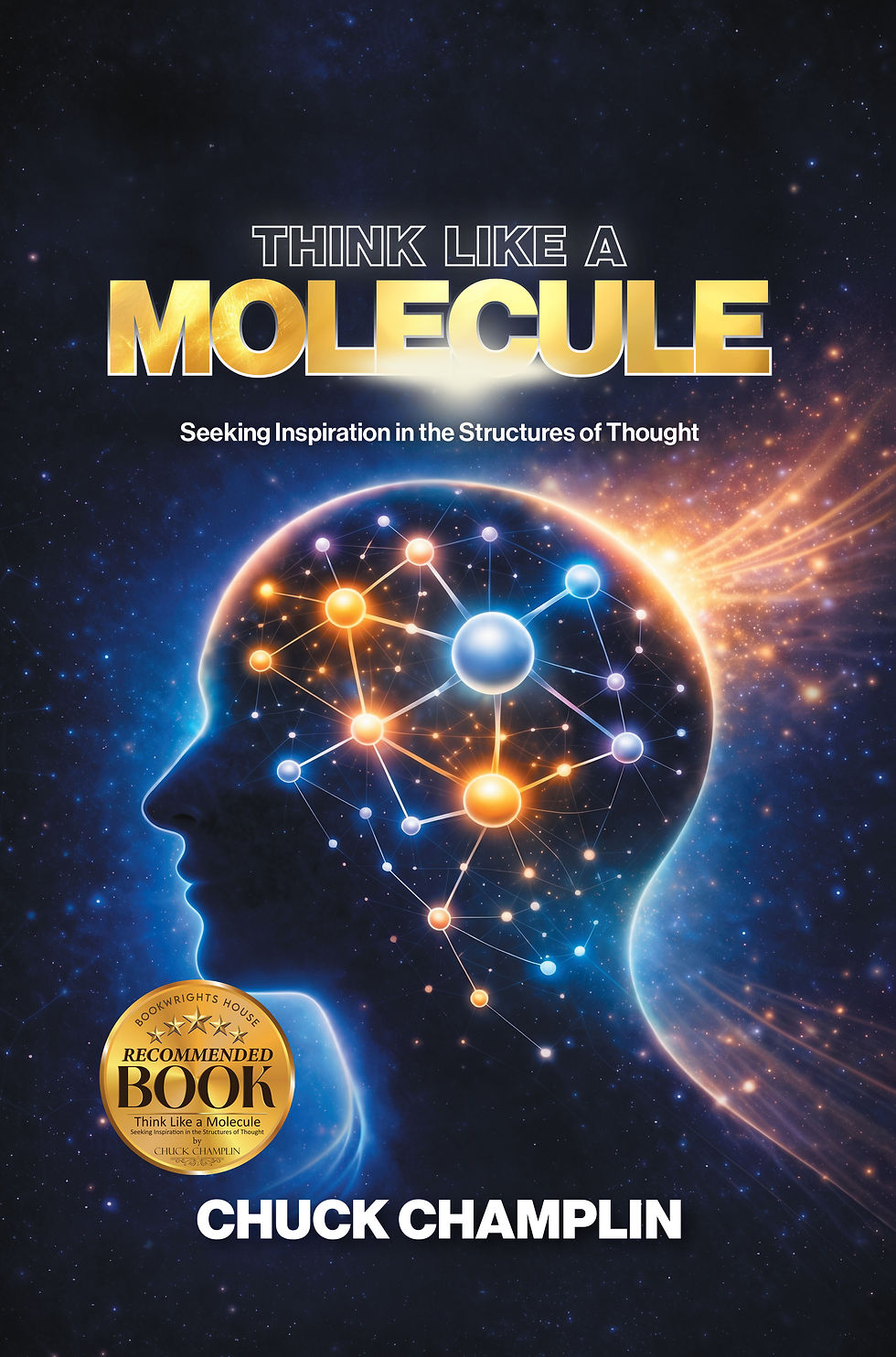
As a work positioned partly in the self-help genre, Think Like A Molecule occasionally sacrifices philosophical depth for motivational punch. The leap from "matter self-assembles" to "here is how you should organize your creative practice" is intuitively appealing but logically porous. Champlin's practical suggestions—embracing curiosity, welcoming uncertainty, recognizing one's potential—are sound enough, but they sometimes feel less derived from molecular science than decorated with it.
At a relatively compact length, the book covers an extraordinary range: quantum physics, biochemistry, evolutionary theory, consciousness studies, creativity research, and speculative futurism. The breadth is exhilarating; the depth, necessarily uneven. Certain passages read as informed sketches rather than sustained arguments.
Champlin's background as a Disney communications executive is worth noting. He understands narrative architecture, and it shows. The book is structured as a journey, with the reader as protagonist, molecules as mentors, and infinite potential as the destination. This is not incidental packaging—it is the methodological point. If molecules "just are," then meaning and direction must be supplied by conscious observers. Champlin supplies them generously, crafting a story in which scientific literacy becomes a form of self-knowledge. His journalistic training also serves him well. He interviews ideas rather than interrogating them, presenting multiple perspectives with equanimity and trusting readers to draw their own conclusions.
Think Like A Molecule succeeds as a work of creative nonfiction precisely because it practices what it preaches. Like the molecular systems it describes, the book assembles disparate elements—hard science, spiritual intuition, creative methodology, narrative craft—into something functional and, at its best, genuinely illuminating.
It will not satisfy readers seeking rigorous philosophical argument or exhaustive scientific exposition. But for those open to an imaginative, good-faith exploration of how physical reality gives rise to conscious creativity, Champlin offers a rewarding journey. The book's final movement, from molecular awareness to "the twinkling stars of our infinite potential," could easily collapse into cliché. In Champlin's hands, it feels earned—a logical extension of the wonder that proper scientific attention to the natural world reliably produces.
Creative professionals seeking fresh metaphors for their practice; science-curious general readers; anyone who has looked at the night sky or through a microscope and wondered how the two perspectives connect. A genuinely original synthesis, occasionally thin in argumentation but rich in insight and consistently engaging in execution.
— Reviewed by Danice Brooke


Comments