
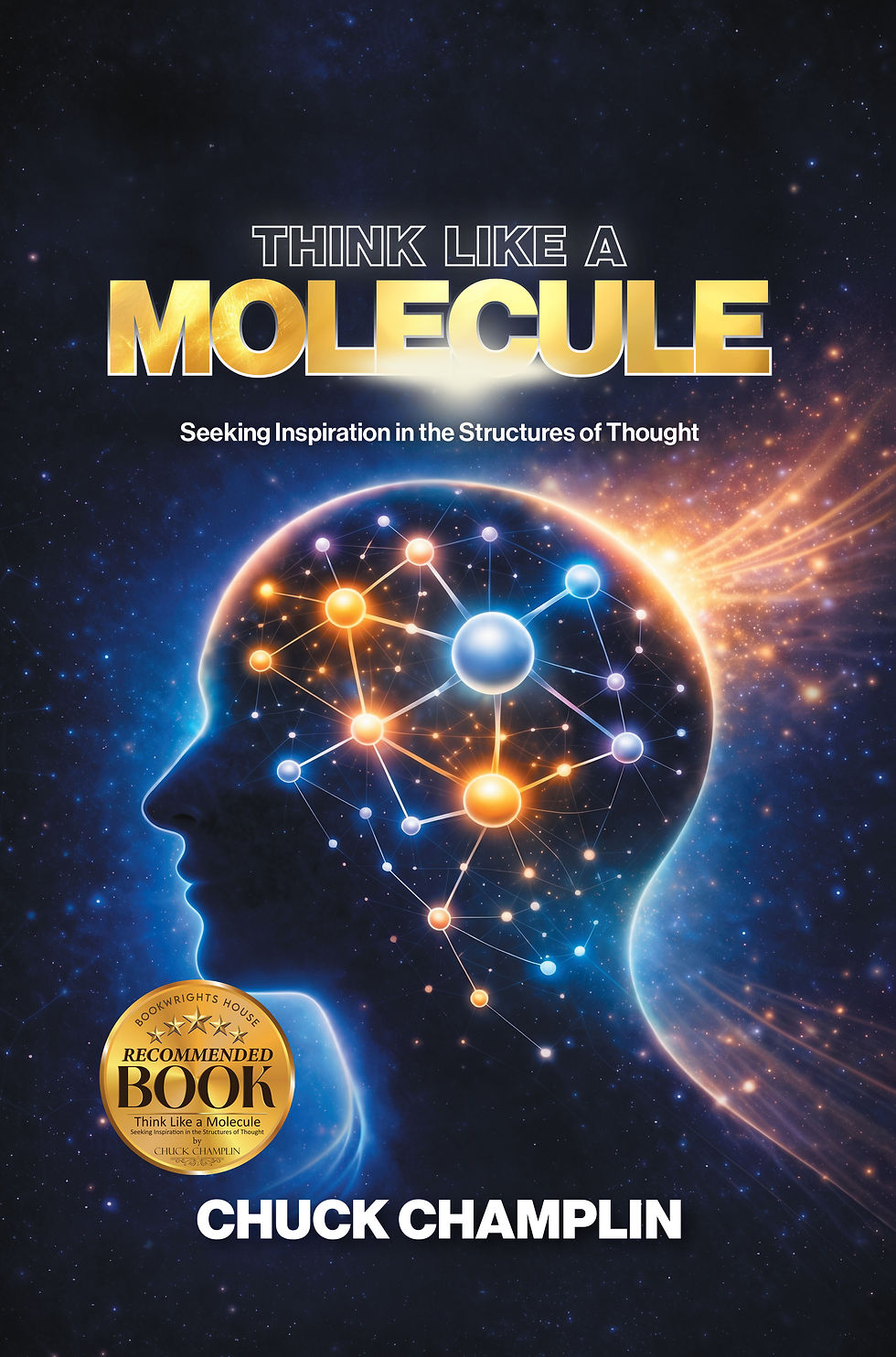
Cosmic Wonder Meets Practical Innovation: A Review of Think Like a Molecule
Updated: Aug 31


Despite dealing with cosmology, quantum mechanics, and psychology, the book never talks down to readers or overwhelms them with jargon. Diagrams and illustrations support comprehension effectively. The Twinkle concept is genuinely novel — a memorable, actionable tool for creative thinking that bridges pop culture and cognitive science. Champlin successfully synthesizes science, philosophy, history, and creative arts into a coherent whole, demonstrating the interconnectedness he advocates.
The book's optimism is infectious. Champlin's genuine wonder at the mysteries of nature and the cosmos is contagious and motivating. Unlike many self-help books that offer only inspiration without method, Champlin provides concrete tools (Twinkles) and a clear paradigm (molecular thinking) that readers can apply immediately. At just 126 pages, the book respects readers' time while delivering substantial content. Nothing feels padded or unnecessarily expanded.
In an era defined by rapid technological change, climate crisis, and growing inequality, Think Like A Molecule offers something increasingly rare: a hopeful framework for creative problem-solving rooted in natural systems thinking. The book's emphasis on collaboration over competition, emergence over control, and wonder over cynicism resonates strongly with contemporary movements in:
Sustainability and biomimicry: Learning from nature's 3.8 billion years of R&D
Design thinking: Human-centered approaches to innovation
Systems theory: Understanding complex adaptive systems
Mindfulness and creativity: Bridging contemplative practices with productive action.
Champlin's background at Walt Disney — an institution built on imaginative storytelling and technical innovation — informs his conviction that creativity is not mystical but methodical. This democratizes inspiration: anyone can learn to think like a molecule. The book also speaks to growing public interest in cosmic perspective — the idea that understanding our place in the universe can transform how we live on Earth. In this tradition, Champlin joins Sagan, Tyson, and other science communicators who use astronomical wonder as fuel for earthly engagement.
Ideal readers who would like to explore are those creatives seeking practical frameworks for generating ideas. Scientists and engineers interested in philosophy and meaning, educators looking for innovative teaching metaphors, and managers and leaders practicing systems thinking. Anyone feeling stuck in conventional problem-solving approaches, fans of popular science writing, and readers of creative literature.


An eye-opener perspective!