
The Universe Thinking About Itself: Systems Thinking, Science, and Human Awe in Think Like A Molecule

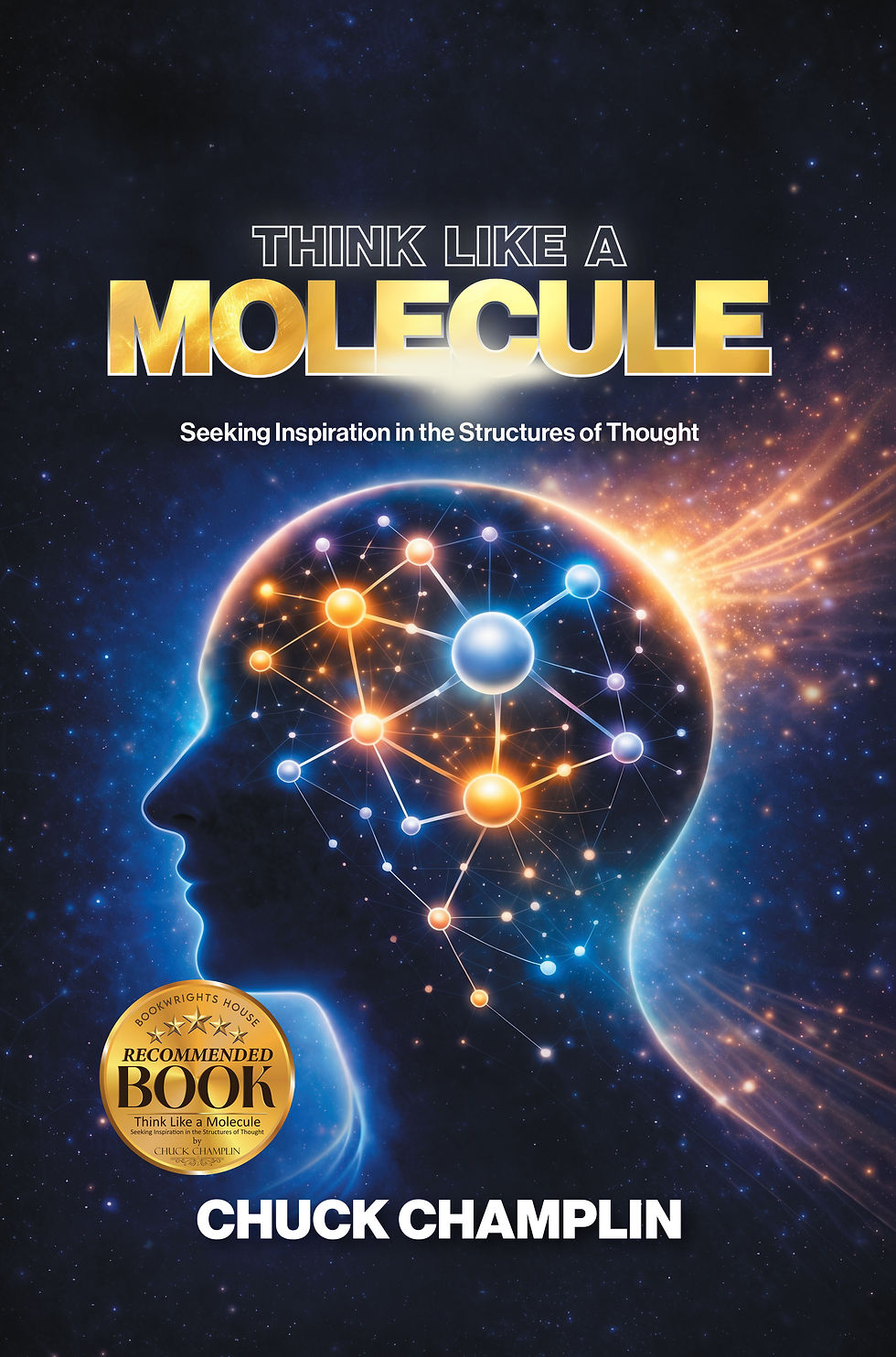
One of society's persistent challenges is bridging the gap between scientific expertise and public understanding. Think Like A Molecule contributes meaningfully to this effort by:
Translating molecular biology into life philosophy without dumbing it do
Referencing respected scientists (Carl Sagan, Buckminster Fuller, Ray Eames) while remaining readable to non-specialists
Using everyday analogies alongside genuine scientific observation
This mirrors the tradition of public intellectuals like Sagan and Stephen Jay Gould, who demonstrated that rigorous science and poetic language coexist productively. Perhaps more importantly, Champlin rekindles a sense of awe — what physicist Richard Feynman called the "pleasure of finding things out." In an era where scientific literacy is increasingly political and contentious, reminding general audiences of the genuine wonder inherent in natural phenomena serves a civic function. It encourages curiosity-driven learning rather than fear-based ignorance.
The book's molecular metaphor aligns with growing recognition that many of society's biggest challenges — inequality, environmental degradation, political polarization — are systemic, not linear. Treating society as a collection of interacting molecules rather than isolated parts encourages policymakers, activists, and citizens to look for leverage points rather than simplistic fixes. This systems perspective has gained traction in fields ranging from urban planning to public health, and works like Champlin's help normalize such thinking in mainstream discourse.
A notable social tension in contemporary society pits scientific materialism against religious faith, often falsely framed as irreconcilable. Champlin occupies a productive middle ground — expressing openness to cosmic consciousness and extraterrestrial intelligence while maintaining scientific skepticism. This resonates with growing segments of the population who identify as "spiritual but not religious" or who seek meaning through naturalistic wonder rather than doctrinal belief. His handling of theology is notably inclusive: acknowledging God as a possibility without requiring belief, which makes the book appealing across a broad spectrum of worldviews.
From the author himself, encapsulating the book's spirit:
"Life, and the mind of man, have created something new in the history of the Universe: namely, the Universe thinking about itself, taking action upon, and thus transforming itself."
This sentiment — that we are the cosmos becoming conscious of itself, capable of intentional creation — is both scientifically defensible and profoundly moving. It's why Think Like A Molecule endures beyond its flaws: it reminds us that thinking itself is a miracle worth cultivating.
— Reviewed by Dennis Mercado



Comments